
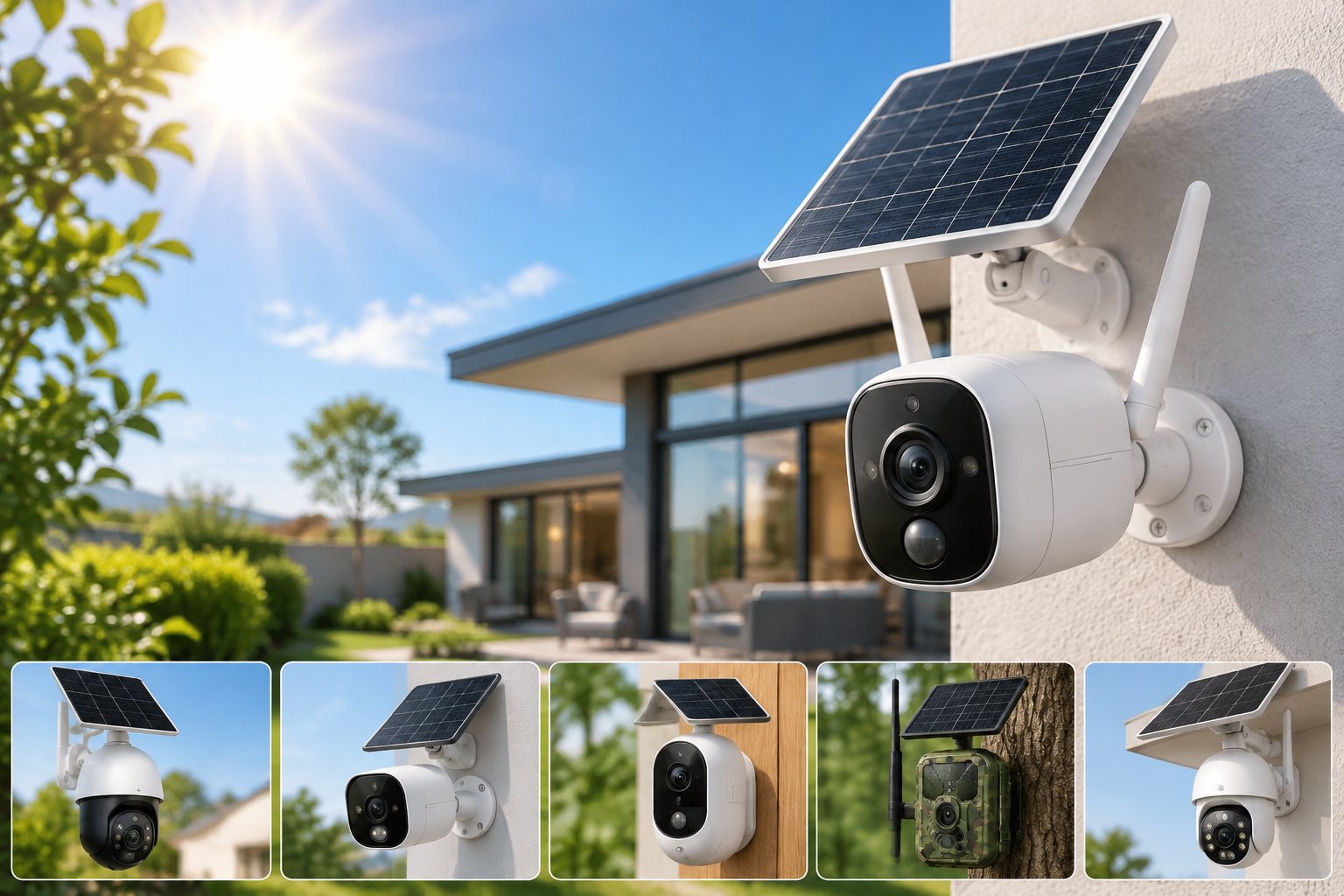
If you need CCTV coverage in a place where running electrical wiring is difficult, a solar-powered wireless camera can be a very practical solution. Farms, construction sites, parking areas, warehouses, remote entrances, and large residential properties are all good examples.
But choosing one isn't simply a matter of picking the camera with the highest resolution or the biggest solar panel. Battery life, mobile connectivity, night vision, storage, weather resistance, motion detection, and the quality of the installation can all affect how useful the system will be.
In this guide, we'll look at 10 of the best CCTV solar-powered wireless cameras to consider in 2026, along with the features that actually matter when you're trying to secure a property.
Editor's note: Camera specifications, availability, subscriptions, and regional connectivity can change. Always verify the current specifications and network compatibility before purchasing.
What Is a Solar-Powered Wireless CCTV Camera?
A solar-powered wireless CCTV camera uses a solar panel to generate electricity and a rechargeable battery to keep the camera operating when sunlight isn't available.
Unlike a traditional wired CCTV Camera, you don't necessarily need to run a permanent power cable to the camera location. Depending on the model, video may be transmitted through Wi-Fi, 4G/LTE, or another wireless connection.
This makes solar cameras particularly useful for locations where conventional electrical installation would be expensive or impractical.
For example, imagine a farmhouse with a gate several hundred metres away from the main building. Digging a trench to install power and network cables could take considerable time and money. A suitable solar-powered 4G camera may provide surveillance at the gate without requiring the same type of cabling.
10 Best CCTV Solar Powered Wireless Cameras in 2026
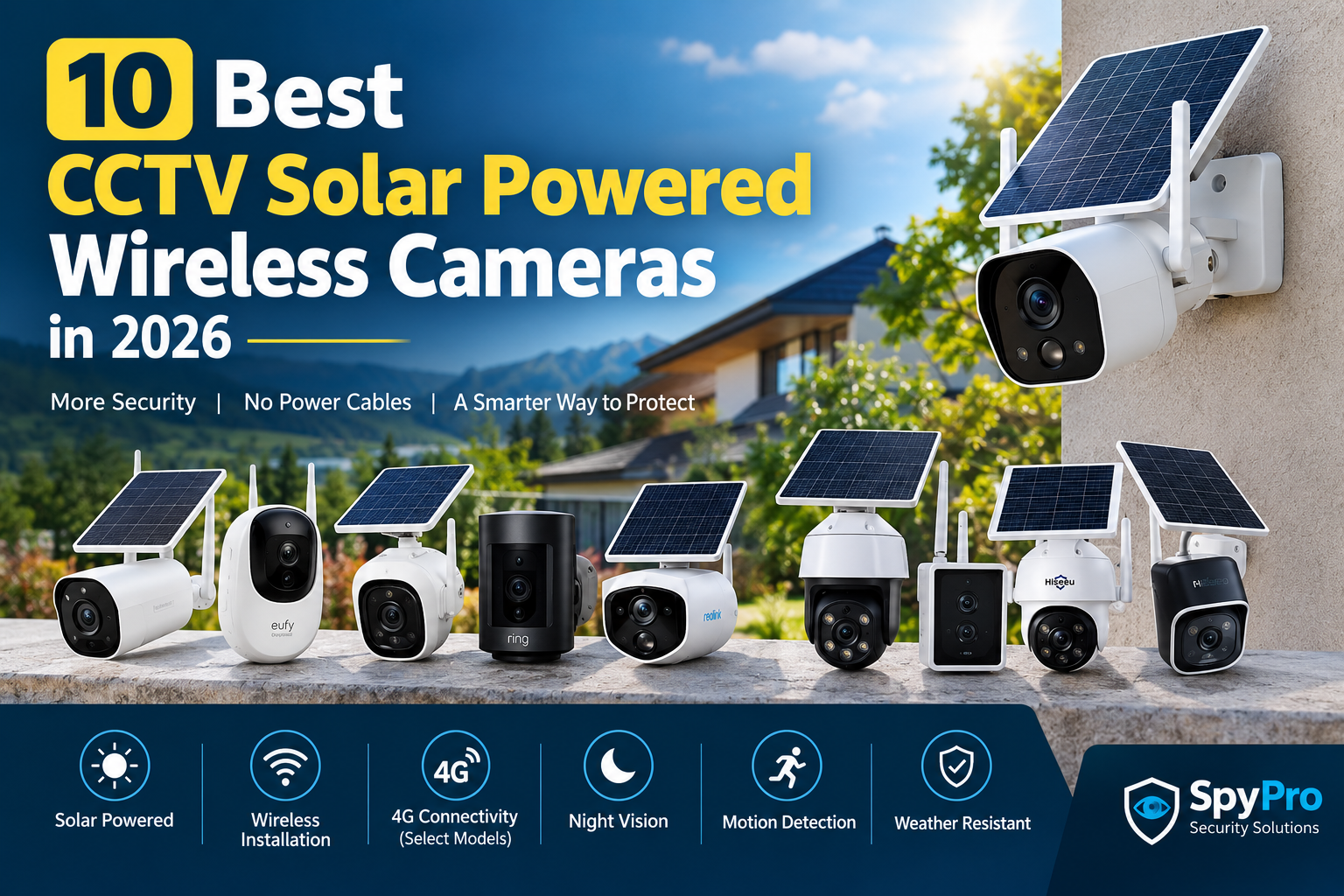
The "best" camera depends heavily on where you plan to install it. A camera that works well beside a house may not be the right choice for a remote construction site.
Here are ten types and models worth considering when comparing the current market.
1. Reolink Go Series Solar Cameras
Reolink's Go range is worth considering for locations without conventional Wi-Fi. Many models are designed around 4G/LTE connectivity and can be paired with solar charging.
They're particularly useful for farms, remote gates, storage areas, and other properties where cellular coverage is available but Wi-Fi isn't.
Best for: Remote properties and locations without Wi-Fi.
2. Reolink Argus Solar Series
For locations with reliable Wi-Fi, the Argus range can be a simpler option. Solar charging can reduce the need to regularly remove and recharge the camera battery.
These cameras can make sense for homeowners who want outdoor monitoring without running a dedicated power cable.
Best for: Homes, gardens, garages, and smaller outdoor areas.
3. eufy Security Solar Cameras
eufy's solar-powered outdoor cameras are another option for homeowners who want wireless installation and app-based monitoring.
One advantage of this category is convenience. Instead of planning a complete wired CCTV installation, you can position the camera where it has a useful view and sufficient sunlight.
Best for: Residential security and DIY installations.
4. Arlo Solar-Compatible Cameras
Arlo offers outdoor security cameras with solar charging options for compatible models. They're worth considering if you already use the Arlo ecosystem or want a polished app experience.
Before purchasing, check exactly which solar accessory is compatible with the camera you select.
Best for: Smart-home users who want app-based monitoring.
5. Ring Stick Up Cam with Solar Charging
Ring's outdoor camera ecosystem is familiar to many homeowners, and compatible solar charging accessories can help reduce battery maintenance.
This can be useful for monitoring entrances, driveways, gardens, and other areas around a residential property.
Best for: Homeowners already using Ring devices.
6. ZOSI Solar-Powered 4G Cameras
ZOSI offers security cameras aimed at applications where conventional Wi-Fi may not be available. 4G connectivity can be particularly useful for remote locations.
When considering a 4G solar camera, don't just look at the camera itself. Check whether the required SIM card, data plan, and local mobile network are suitable for your location.
Best for: Rural properties, farms, and remote monitoring.
7. Hiseeu Solar Security Cameras
Hiseeu has several wireless and solar-powered security options designed for outdoor monitoring.
These can be attractive for buyers looking for a relatively straightforward surveillance setup, although it's still worth checking the exact storage, connectivity, and weather-resistance specifications of the individual model.
Best for: Budget-conscious outdoor surveillance.
8. Reolink TrackMix Solar
For larger outdoor areas, a solar-powered camera with tracking and a wider field of view can provide more useful coverage than a basic fixed camera.
A camera such as the TrackMix Solar is worth examining when you need to monitor movement across a driveway, yard, entrance, or other relatively large area.
Best for: Larger outdoor spaces where tracking is useful.
9. 4G Solar PTZ Cameras
A solar-powered PTZ camera can pan, tilt, and sometimes zoom to cover a much larger area than a fixed camera.
This type of camera is particularly interesting for warehouses, construction sites, agricultural properties, and large compounds.
The trade-off is that PTZ cameras can be more complicated to configure and shouldn't automatically be considered a replacement for multiple fixed cameras.
Best for: Large areas requiring flexible viewing angles.
10. Solar-Powered AI Security Cameras
Some newer outdoor cameras combine solar charging with features such as person detection, vehicle detection, activity zones, and intelligent alerts.
These features can reduce unnecessary notifications. For example, instead of receiving an alert every time a tree branch moves in the wind, the camera may be able to distinguish a person or vehicle from general movement.
Best for: Users who want smarter alerts and reduced false notifications.
How to Choose the Right Solar CCTV Camera
A camera can have impressive specifications on paper and still be a poor choice for your property. Before buying, consider these factors.
1. Check the Network Connection
This is especially important with 4G solar cameras.
If the camera is going somewhere without Wi-Fi, you'll need reliable cellular coverage. Check which 4G/LTE bands the camera supports and whether your local mobile network is compatible.
A good camera is of little use if it cannot maintain a stable connection.
2. Look at Battery Capacity
Solar charging doesn't mean the camera has unlimited power.
During cloudy weather, winter conditions, or periods of heavy activity, the battery may receive less energy than usual. A larger battery can provide more operating reserve.
Also consider how often the camera is triggered. A busy entrance may consume considerably more power than a quiet storage shed.
3. Don't Ignore the Solar Panel Position
A solar panel needs useful sunlight. Installing it underneath a roof overhang or behind a large wall can seriously reduce charging performance.
Ideally, position the panel where it receives good exposure to sunlight while keeping the camera aimed at the area you actually want to monitor.
4. Consider Night Vision
A camera that looks excellent during the day can produce disappointing footage at night.
Look for suitable infrared night vision or, where appropriate, colour night vision. Consider the distance you actually need to identify people or vehicles rather than relying only on a manufacturer's maximum range.
5. Think About Storage
Some cameras use microSD cards, while others offer cloud storage or both.
Local storage can reduce ongoing subscription costs, but you should also consider what happens if someone steals or damages the camera. Cloud storage may provide an additional layer of protection because recordings can be stored away from the camera.
6. Check Weather Protection
Outdoor security equipment needs to withstand rain, dust, heat, and changing temperatures.
Look for the camera's stated IP rating and consider the actual conditions at the installation site. A sheltered residential entrance and an exposed agricultural field present very different challenges.
Solar Camera vs Traditional Wired CCTV
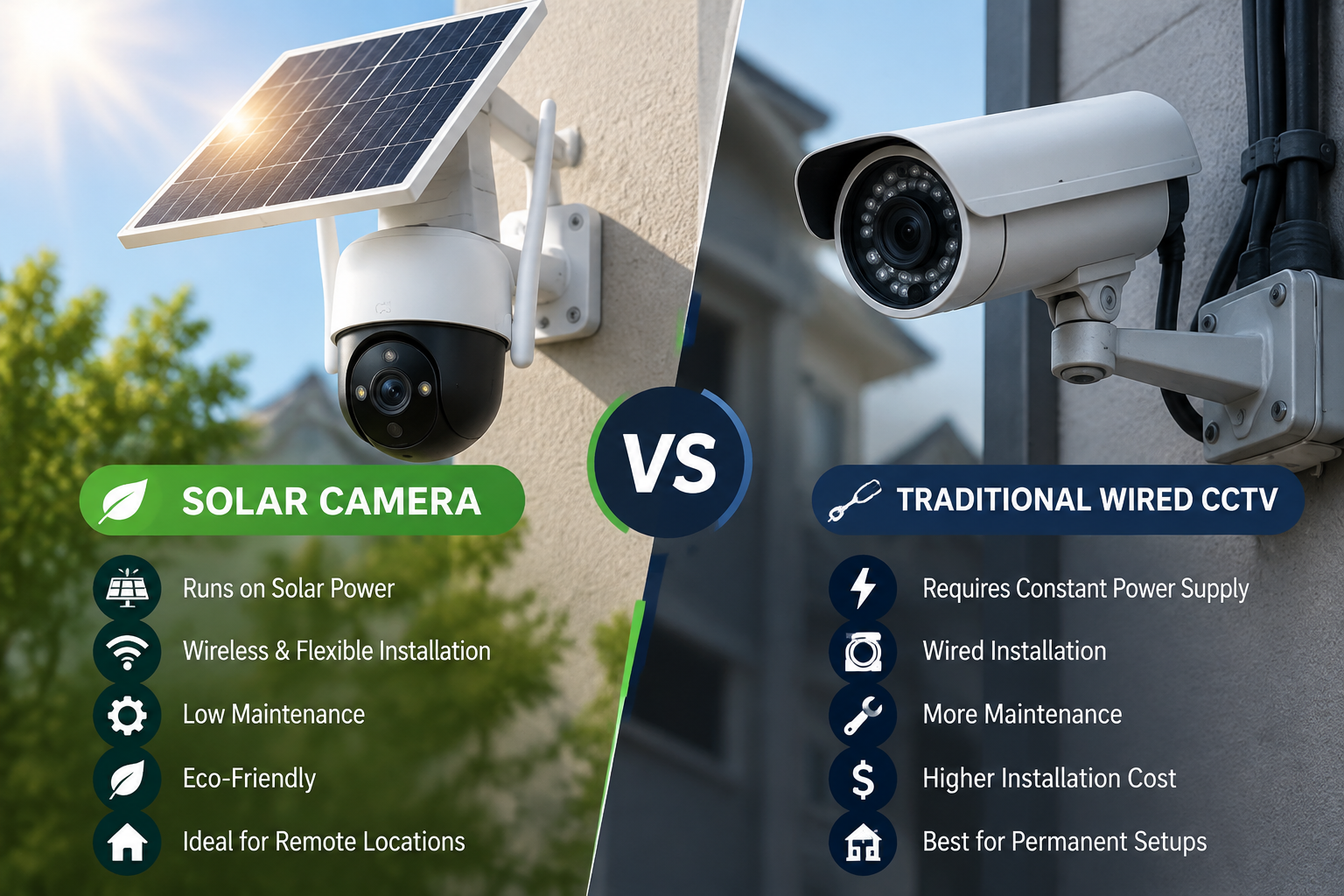
Solar wireless cameras are not automatically better than wired CCTV.
Traditional wired systems can offer continuous power, stable connections, and continuous recording, which can be important for businesses and high-security environments.
Solar cameras, on the other hand, are attractive when installation flexibility matters.
A useful rule is simple:
Choose wired CCTV when you need dependable continuous surveillance and can install the required infrastructure. Choose solar wireless cameras when flexibility and remote installation are higher priorities.
For some properties, a hybrid system is the best answer.
Where 4G Solar Cameras Make the Most Sense
4G solar cameras are particularly useful when Wi-Fi isn't available.
Common applications include:
- Farm entrances
- Construction sites
- Remote warehouses
- Agricultural fields
- Vacation properties
- Large parking areas
- Temporary security locations
- Equipment storage areas
- Remote gates and access roads
For example, a construction company may install a temporary solar camera overlooking an equipment storage area. Once construction is complete, the camera can be moved to another location.
That flexibility is one of the biggest advantages of this type of CCTV system.
What About Spy Cameras?
The term Spy Cameras is often used loosely online to describe small or discreet cameras. However, discreet doesn't mean that a camera should be used without regard for privacy laws or the rights of people being recorded.
For legitimate security applications, the priority should be responsible surveillance. Cameras should be installed in appropriate locations, and users should understand applicable privacy and recording requirements.
For most outdoor property-security needs, a properly installed visible CCTV Camera is usually the more straightforward approach.
Common Mistakes to Avoid
Installing the Camera Too High
A camera mounted extremely high may cover a large area but produce poor facial detail.
Think about what you need the footage to accomplish. Detection and identification are not the same thing.
Choosing Resolution Over Everything Else
Higher resolution is useful, but it doesn't solve poor lighting, bad positioning, weak connectivity, or inadequate storage.
A well-positioned 2K camera can sometimes provide more useful evidence than a poorly positioned camera with a much higher advertised resolution.
Forgetting About Mobile Data
A 4G camera generally needs a suitable mobile data connection. Calculate how much data the camera may use and check whether the SIM plan is appropriate.
Depending Entirely on Solar Charging
Solar power is highly useful, but it isn't magic.
Long periods of poor weather, heavy motion activity, shade, or an incorrectly positioned panel can affect battery performance. Check the battery regularly after installation, particularly during the first few weeks.
Ignoring the Field of View
Before mounting the camera, stand roughly where the lens will be positioned and consider what it can actually see.
A camera pointed at the wrong angle won't become useful simply because it has excellent specifications.
Practical Tips for Better CCTV Coverage
Before permanently installing your camera:
- Test the mobile or Wi-Fi signal at the exact installation location.
- Check the solar panel's exposure to sunlight.
- Walk through the monitored area and check the camera's viewing angle.
- Test night footage rather than relying only on daytime images.
- Configure motion zones to reduce unnecessary alerts.
- Set the correct date and time on the camera.
- Use strong account passwords and enable two-factor authentication where available.
- Keep the camera firmware updated.
- Protect the camera and solar panel from easy tampering where possible.
- Check recordings periodically to make sure the system is actually working.
Frequently Asked Questions
Are solar-powered CCTV cameras reliable?
They can be very reliable when correctly selected and installed. Reliability depends on sunlight, battery capacity, network connectivity, weather conditions, camera activity, and installation quality.
Do solar CCTV cameras work at night?
Yes. The solar panel charges the battery during daylight, while the battery powers the camera at night. The exact runtime depends on the camera, battery, environmental conditions, and activity level.
Do 4G solar cameras need Wi-Fi?
No. A 4G model can connect through a compatible cellular network instead of Wi-Fi. However, it normally requires a suitable SIM/data plan and adequate mobile coverage.
How far can a solar CCTV camera see?
There isn't one universal answer. Detection range and useful identification distance can be very different. Lens type, resolution, lighting, zoom, and the size of the object all matter.
Are solar cameras better than wired CCTV?
Not necessarily. Solar cameras offer easier installation and flexibility, while wired CCTV can be better for continuous recording and installations where reliable power and network infrastructure are available.
Can a solar CCTV camera record continuously?
Some models and configurations may support continuous recording, but battery-powered cameras are often designed around power-saving operation and event-based recording. Check the individual model's specifications before purchasing.
Can solar cameras work during cloudy or rainy weather?
Yes, provided the battery has sufficient stored energy. However, extended periods of limited sunlight can reduce the amount of energy available for charging.
Should I install CCTV myself or hire a professional?
A simple residential camera may be suitable for DIY installation. For larger properties, multiple cameras, commercial premises, or locations where evidence quality is critical, professional planning and installation can make a significant difference.
Final Thoughts
The best solar-powered CCTV camera isn't necessarily the one with the longest advertised range or the highest resolution. It's the one that fits your location, connectivity, power requirements, viewing area, and security objectives.
For remote locations, 4G solar cameras can be particularly useful because they don't depend on a nearby Wi-Fi network. For homes, Wi-Fi-based solar cameras may offer a simpler setup. Larger properties may benefit from PTZ cameras or a combination of fixed and tracking cameras.
Before buying, focus on the things that will matter six months after installation: battery performance, network reliability, night footage, storage, weather resistance, and ease of maintenance.
If you're unsure which setup would work best for your property, SpyPro Security Solutions could be a useful option to explore for professional advice, site assessment, and CCTV installation. The right security system should be designed around the property—not simply around a product specification sheet.